Google Tried to Sue Web Scraping Out of Existence. A Judge Just Threw the Case Out
A federal judge dismissed Google's DMCA lawsuit against SerpApi, ruling that search results are facts, not copyrighted works — and that an anti-bot wall doesn't turn scraping into piracy. Here's what the ruling says and why it matters.
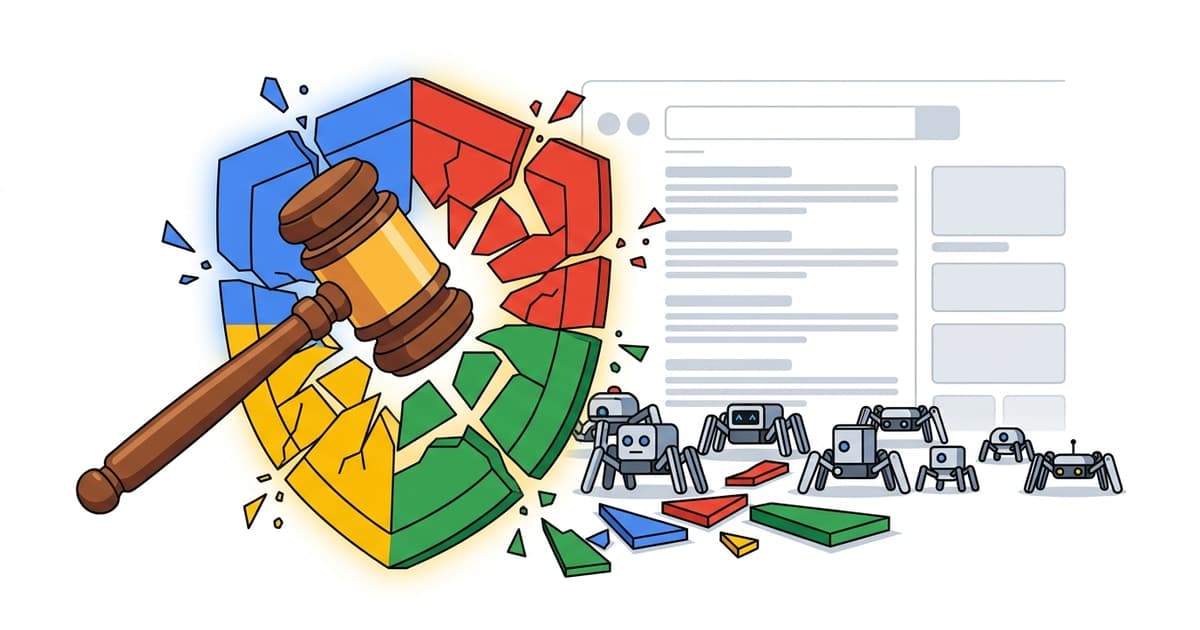
Google spent years being the company that scraped the entire web. Last week, a federal judge reminded it of that legacy in the most concrete way possible: by dismissing every claim in Google's copyright lawsuit against SerpApi, the 42-person company that scrapes Google's search results and sells them back to developers as an API.
In an order dated July 20, Chief Judge Yvonne Gonzalez Rogers of the U.S. District Court for the Northern District of California granted SerpApi's motion to dismiss Google LLC v. SerpApi LLC — a case Google filed in December 2025 that many saw as an attempt to redefine the legal status of web scraping itself.
The case: an anti-bot wall as a copyright lock
Google's argument was built on a system called SearchGuard, an anti-bot defense it rolled out in early 2025. SearchGuard challenges suspicious traffic with a JavaScript test that normal browsers pass invisibly and automated scrapers typically fail. Google's legal theory: SearchGuard is a "technological protection measure" under Section 1201 of the Digital Millennium Copyright Act — the same anti-circumvention law written to stop DVD decryption and software piracy — so bypassing it to scrape search results is illegal circumvention, and selling a scraping API is trafficking in circumvention tools.
The stakes were enormous. Google told the court that SerpApi's scraping had grown by as much as 25,000% over two years, and it sought statutory damages of $200 to $2,500 per act of circumvention — a formula that, applied to millions of daily queries, produces numbers with no practical ceiling. Had the theory survived, any site could potentially convert its bot-detection into a legal weapon against scrapers, with existential implications for the data pipelines that feed AI companies, price-comparison tools, and SEO platforms.
What the judge actually ruled
Judge Gonzalez Rogers rejected the foundation of the case, as detailed in PPC Land's breakdown of the order. Section 1201 protects measures that control access to copyrighted works — and ordinary search results, the court found, aren't that. URLs, links, and snippets of factual index data are publicly accessible facts, not Google's creative expression. A gate in front of content that copyright doesn't protect isn't a copyright lock; it's just a gate. Those core claims were dismissed outright, with no opportunity to refile them.
One piece survives on life support: Google also argued that some search pages contain genuinely copyrighted material, like licensed images in Knowledge Panels. The judge dismissed those claims too — Google never alleged that the actual copyright owners authorized SearchGuard to protect their works, a requirement under the statute — but gave Google 21 days to try to replead them.
SerpApi, which had argued the DMCA "was written to protect encrypted DVDs and software from piracy" rather than to wall off public web pages, celebrated. "A win not just for SerpApi, but for all who depend on an open internet," CEO Julien Khaleghy said of the ruling.
The irony nobody missed
Commentators were quick to point out the obvious, as the discussion around the ruling shows: Google's index — the foundation of a multi-trillion-dollar business — was built by scraping the web without asking anyone's permission first. The company now finds itself on the receiving end of the same practice, at the exact moment AI companies large and small are hammering its results pages for training data and live retrieval.
That context is what makes this more than a contract dispute between two companies. Google has been steadily hardening its results against automated access as AI search eats into its click economy — a shift we covered in our breakdown of what AI search is doing to SEO. The DMCA theory was arguably its most aggressive move yet: not blocking scrapers technically, but making the act of scraping legally radioactive. For now, that door is closed.
What happens next
Google can amend the narrower Knowledge Panel claims within 21 days, and it retains other legal avenues it hasn't fully tested here — breach of terms of service and trespass-style theories among them. Technical escalation is also certain to continue: rulings don't disable anti-bot systems, and SearchGuard keeps running regardless of what the court said about its legal status.
But the headline holds: a federal court has said that publicly visible facts don't become copyrighted just because a company puts a bot-wall in front of them. In a year when the fight over who may read the open web — humans, scrapers, or AI crawlers — has become the defining tension of the internet economy, that's a precedent both sides will be citing for a long time.
FAQ
Did Google lose the case completely?
Mostly. The core claims — that scraping ordinary search results past its anti-bot system violates the DMCA — were dismissed with no option to refile. Only a narrower claim about licensed images in Knowledge Panels can be amended, within 21 days of the July 20 order.
Does this mean scraping Google is now legal?
Not exactly. The ruling says the DMCA's anti-circumvention law doesn't apply to scraping uncopyrighted search data. Google can still fight scrapers technically and may pursue other legal theories, such as terms-of-service claims. What it can't do, per this ruling, is treat search scraping like DVD piracy.
What is SerpApi?
A company of roughly 42 people that provides an API for structured Google search results — used by SEO tools, researchers, and AI applications. Google sued it in December 2025 after launching its SearchGuard anti-bot system.
Why does this matter for AI?
Modern AI products depend heavily on scraped web data, for both training and live search retrieval. If bypassing any anti-bot wall had become a DMCA violation with per-query statutory damages, the legal exposure across the AI industry would have been enormous. The ruling keeps public facts on the open side of the law — for now.
About the author
UbedullaFounder & Editor
Founder and editor of The Bot Post, covering AI news and technology.