Microsoft Maia 300: 96 Chips, 167 kW Racks and a Multi-Gigawatt 2027 Rollout
Microsoft's third-gen Maia 300 AI chip uses TSMC N2P and 288GB of HBM4. Specs, the 167 kW rack maths, 2027 rollout and what's unverified.
Microsoft has unveiled Maia 300, its third-generation in-house AI chip, and says it will become the "primary inference system for Microsoft products and services." Each rack holds 96 of the chips inside a 167-kilowatt power envelope, and Microsoft plans "multi-gigawatt deployments" of its Maia family starting in 2027.
The headline efficiency claim is 40% more tokens per megawatt than "leading GPU-based systems." That is Microsoft's own figure, against unnamed rivals, for a chip that has not yet shipped.
Based on Microsoft's announcement by Scott Guthrie and its Azure technical deep dive (both October 12, 2026), plus reporting from The Verge, CNBC, Reuters (via Techmeme's summary) and Yahoo Finance, checked October 13, 2026. We have not tested Maia hardware; all performance figures are Microsoft's claims.
What Microsoft announced
In a blog post by cloud chief Scott Guthrie, Microsoft said Maia 300 "will begin production deployments in 2027." The chip was shown at the OCP Global Summit in San Jose, according to Yahoo Finance.
It follows Maia 100 in 2023 and Maia 200, announced in January. Microsoft says Maia 200 already serves Microsoft Copilot and runs OpenAI models, its own MAI models and open-source families, in the US, Europe and Australia. GitHub Copilot and Microsoft Foundry are due to follow by the end of this year.
Maia 300 is aimed at inference, the work of running trained models, not training them. Microsoft lists long-context reasoning, fast conversational responses and multi-step agent tasks as targets, with GitHub's agentic coding, Foundry model serving and Dragon Copilot among planned uses.
Maia 300 specs, as Microsoft states them
The Azure architecture deep dive and Guthrie's post give these numbers:
- Process: compute chiplets on TSMC's N2P node, with memory-controller and I/O functions on separate dies.
- Memory: eight HBM4 stacks, 288GB, and 18TB/s of bandwidth per chip.
- Power: a 950-watt TDP per chip.
- Formats: "enhanced MXFP4" and sub-3-bit storage formats to cut memory and bandwidth needs.
- Versus Maia 200: 36% more compute FLOPs, 2.5 times the memory bandwidth, 33% more capacity and 14% more scale-up bandwidth.
- Networking: a custom Ethernet-based "AI transport" linking up to 128 racks, or 12,288 chips, into one "superpod."
Microsoft did not publish absolute compute figures such as FP4 or FP8 petaflops, which makes direct comparisons with other accelerators difficult.
Inside the 96-chip, 167 kW rack
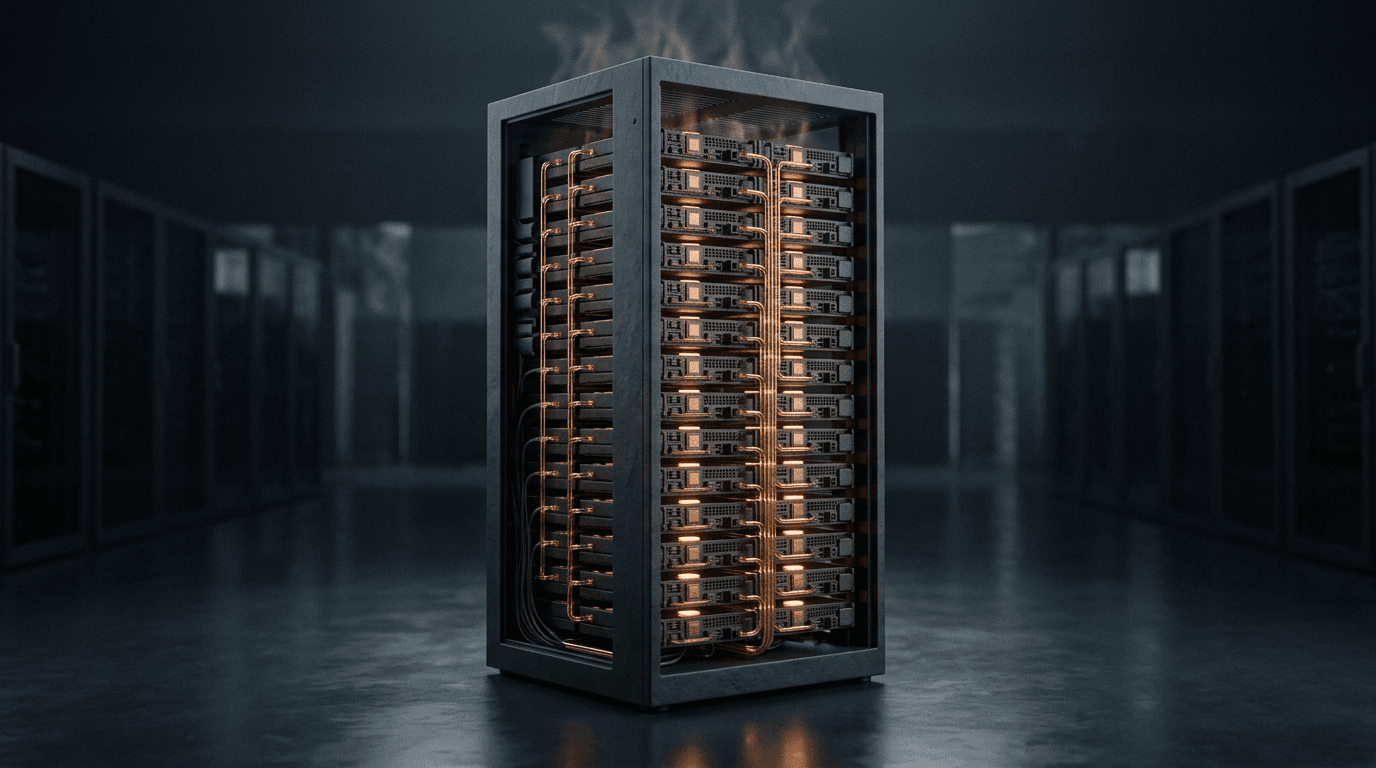
Each rack packs 96 accelerators into 24 trays of four, each tray with its own host processor, memory, storage and cooling. That doubles Maia 200's density. Microsoft quotes 27.6TB of HBM and 1.7PB/s of aggregate memory bandwidth per rack. Liquid cooling handles more than 80% of the heat, and a heat-exchanger option lets racks run in air-cooled data centres.
Our calculation: 167kW divided by 96 chips is about 1.74kW per chip slot. That is not the chip's own draw. It covers host CPUs, memory, storage, network switches, fans, pumps and power-conversion losses. Using Microsoft's 950W TDP, the 96 accelerators account for about 91kW, or roughly 55% of the rack envelope.
Scaling up is also our arithmetic. At 167kW a rack, one gigawatt of rack power covers about 6,000 racks, or about 575,000 Maia 300 chips. Real deployments need extra power for facility cooling and overhead, so the true figure per gigawatt would be lower. Microsoft has not said how many chips it plans to deploy.
Microsoft's claims against Nvidia-style GPUs
Microsoft's headline is that "we expect Maia 300 to deliver 40% more tokens per megawatt compared to leading GPU-based systems." It does not name the systems. It also claims "up to 7x the rack-scale token throughput of Maia 200" in a full rack, and more than 2.5 times Maia 200's performance per watt.
For Maia 200, Microsoft claims "up to 1.7x more tokens per watt" than leading GPU infrastructure for AI features in Teams, Copilot and Cowork. CNBC reported that CEO Satya Nadella told analysts in July that Maia 200 "delivers 30% better performance per dollar than the latest generation hardware in our fleet."
These are vendor figures. As Patrick Moorhead, CEO of advisory firm Moor Insights and Strategy, told CNBC: "Nobody has tested them outside of Microsoft yet."
Why Microsoft, Google and Amazon build their own chips
The reasons executives gave are power, cost and control. "You can think of power translating pretty directly into operational cost for something like a data center," Microsoft general manager Alistair Speirs told CNBC. Finance chief Amy Hood said in-house chips had helped with "margin improvement over the course of a decade," CNBC reported.
Microsoft AI chief Mustafa Suleyman told The Verge: "At that scale we need a platform that we own, and that we co-design with our models." Yahoo Finance noted that Amazon, Google, Meta, OpenAI and Anthropic also have or are building custom chips, partly as a hedge against dependence on Nvidia and AMD.
There is a difference, though. Unlike Google's TPUs or Amazon's Trainium and Inferentia, Maia chips cannot be rented by outside companies, CNBC noted. Microsoft hardware chief Rani Borkar said, according to Mint: "Our own AI services business is big enough that we want to serve ourselves first."
The catch: big claims, few independent numbers
- No outside benchmarks. The 40% and 7x figures are Microsoft's, against unnamed GPU systems and its own older chip.
- No firm volume. Microsoft says "multi-gigawatt" but no exact figure. Speirs told CNBC the company would "reserve a little bit of optionality." Some outlets, citing Reuters, report plans for potentially more than a million chips next year; we could not access Reuters' article to confirm that detail.
- Nvidia is not going away. Speirs said Microsoft still partners with Nvidia and AMD for training. Evercore ISI analysts estimated Maia will be about 10% of Microsoft's AI chip spending by the first quarter of 2027, CNBC reported.
- It ships next year. Production deployments start in 2027. Microsoft says it will share more at its Ignite event next month.
For Copilot, GitHub and Azure Foundry users, the practical effect, if Microsoft's efficiency claims hold, is cheaper capacity behind those services. You will not buy or rent a Maia chip directly.
Frequently asked questions
When will Maia 300 be in use?
Microsoft says production deployments begin in 2027, as part of multi-gigawatt Maia deployments starting that year. Maia 200 is already running Microsoft Copilot today.
How much power does one Maia 300 use?
Microsoft gives a 950W TDP per chip and 167kW per 96-chip rack. Our rough split is about 1.74kW per chip slot once host CPUs, switches, cooling and power losses are included.
Is Maia 300 faster than Nvidia's chips?
Microsoft claims 40% more tokens per megawatt than leading GPU-based systems but does not name them or publish absolute compute figures. No independent tests exist yet.
Maia 300 is Microsoft's clearest bet yet that running AI cheaply matters as much as raw performance. Whether that bet pays off will depend on figures outsiders can check in 2027.
About the author
UbedullaFounder & Editor
Founder and editor of The Bot Post, covering AI news and technology.