Surface Laptop Ultra Starts at $2,599. What Does 128GB Buy an AI User?
Microsoft’s AI-focused laptop opens for preorders. We unpack shared memory, the one-petaflop claim and the tests that matter before spending thousands.
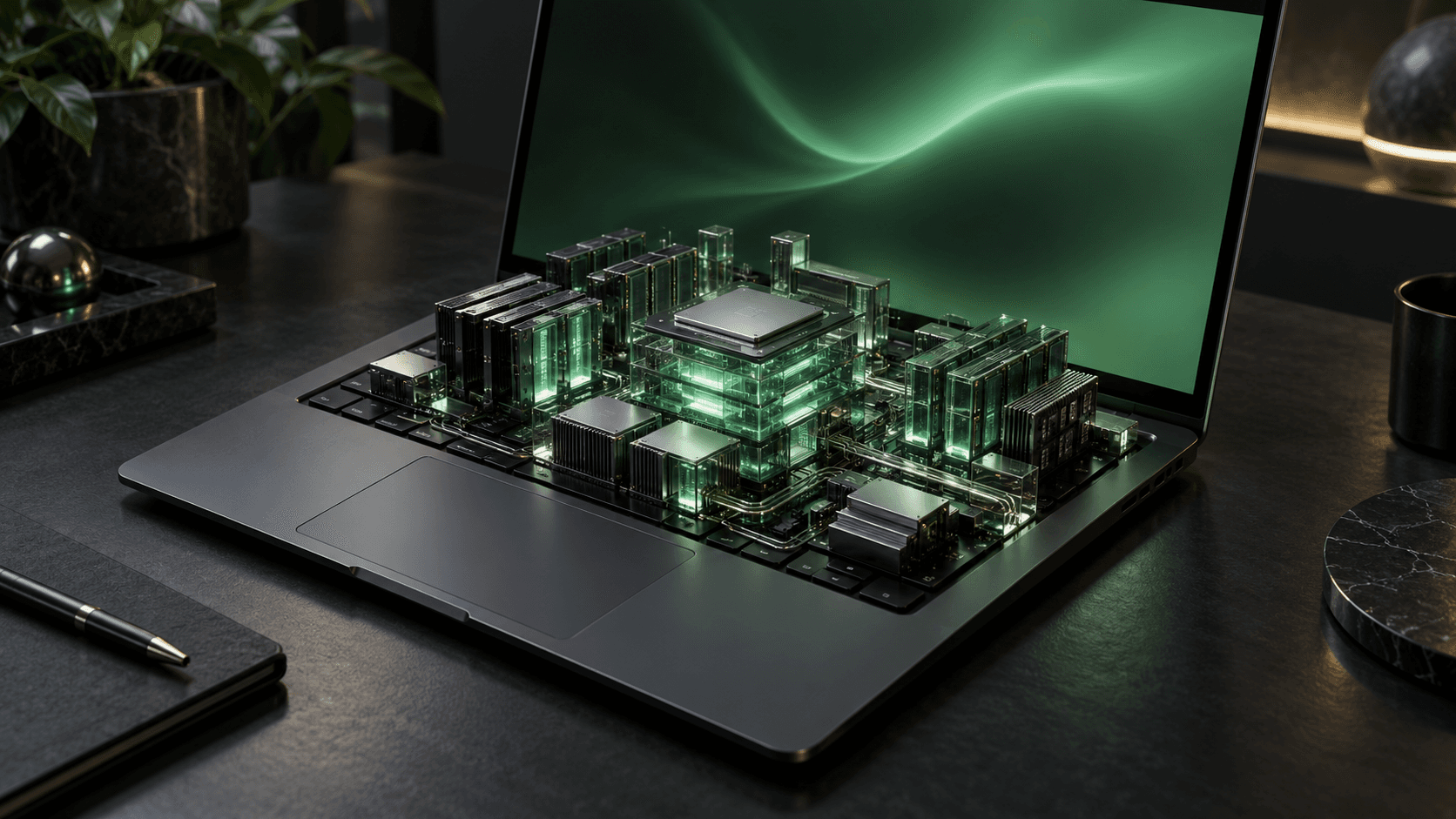
Microsoft wants your next serious AI machine to fit in a laptop bag. Whether that is exciting or expensive depends on what you need it to do.
Surface Laptop Ultra preorders opened October 7 from $2,599, with availability beginning October 16. Microsoft’s announcement targets creators, developers and local AI users.
The useful question is what that hardware lets you do after the presentation ends. Can it run the model and tools you need, for long enough, at a speed worth paying for?
Why 128GB attracts more attention than another AI button
The RTX Spark machine offers up to 128GB of shared system memory; less is GPU-addressable. Maximum memory is configuration-dependent, not promised at the entry price. Microsoft specifies these qualifications.
For readers accustomed to cloud chatbots, the appeal of more local memory can be easy to miss. When a model runs remotely, somebody else is responsible for fitting it into hardware. Running it on your laptop makes that your problem.
Here is a simplified sizing example. A hypothetical 120-billion-parameter model stored at four bits per parameter would need 60 billion bytes—about 60GB in decimal units—for raw weights alone:
120 billion × 4 bits ÷ 8 = 60 billion bytes.
That calculation excludes quantization metadata, runtime buffers, conversation state, the operating system and your other applications. It also says nothing about speed. It is a way to understand why memory capacity matters, not a compatibility or performance result for this laptop.
The catch in the one-petaflop headline
The one-petaflop claim is theoretical FP4 performance using sparsity, according to Microsoft’s footnote. That qualification describes particular calculation assumptions, not measured application speed.
A buyer cannot convert that headline directly into words per second in a chatbot. The chosen model, software implementation, context length and workload all need to be part of a meaningful comparison.
Consider two jobs. One is producing a short reply after loading a small model. The other is searching a large repository, reading files and attempting fixes over multiple steps. Even if both use AI, the bottleneck and the measure of success can differ.
For the second job, I would want to know whether the correct fix passed the project’s checks, how long the complete attempt took and what happened after repeated attempts. A fast first response would be encouraging, but incomplete evidence.
The software story deserves its own line in the buying decision
Alongside the hardware push, Microsoft’s Windows AI developer update describes Windows ML support for GGUF and ONNX models through a text-generation interface. It also describes a local endpoint compatible with the OpenAI API format.
That could make it easier for developers to experiment with local inference. Compatibility with an API format, however, should not be confused with matching a particular hosted model’s behavior or capabilities.
For a practical evaluation, start from your existing project. Does its runtime support the chosen model? Do the dependencies install cleanly? Does a tool call have the shape the application expects? Can your app recover when the model returns something unusable?
These questions sound less exciting than a silicon announcement. They are also what separates a machine you can use every day from a demonstration you enjoyed once.
Which price are you actually looking at?
The US business store listing separately showed a $2,749.99 starting price. Consumer and business offers should not be treated as interchangeable quotes.
Before comparing this laptop with a desktop or an existing machine, price the exact configuration and market. A headline memory ceiling, a base price and a maximum-performance claim may describe different operating conditions or configurations.
The sensible comparison is the extra cost required to solve your problem. If your current laptop already handles your daily work, the relevant question is whether local AI removes a real limitation. If you frequently work without reliable connectivity or need to experiment with models on-device, the evaluation may look different.
We have not tested Surface Laptop Ultra. There are no independent battery, thermal or sustained-performance measurements in this article, and we are not using Microsoft’s claims as a substitute for them.
Four tests I would want before recommending it
- A complete real workload: the actual model, project and tools a buyer intends to use.
- A sustained run: performance after the machine has been busy, with fan noise and power conditions recorded.
- A memory-pressure test: AI running beside an editor, browser and other everyday software.
- A comparison at the same settings: identical model, precision and context, with correctness assessed as well as speed.
There is a related distinction in our EmbeddingGemma 2 explainer: local AI can mean finding a photo with a compact retrieval model, or running a much larger generative system. The hardware needed for one does not automatically describe the other.
Quick answers
Should I buy it purely for the biggest advertised model size?
We would first compare a real workload at the exact configuration price. Loading a model and completing useful work at an acceptable speed are separate questions.
What should I keep from a benchmark?
Record the model, precision, context, power conditions, total time and correctness. Those details make results easier to compare later.
Researched October 8, 2026. Sources: Microsoft’s preorder announcement, US business store listing and Windows AI developer update. Prices and specifications are vendor-reported; the memory calculation and evaluation checklist are The Bot Post’s analysis. AI-assisted analysis, not a hardware review.
About the author
UbedullaFounder & Editor
Founder and editor of The Bot Post, covering AI news and technology.