Amazon's $75 and $100 Bee AI Recorders: What They Keep and What They Don't Say
Amazon's Bee Frontier ($74.99) and Bee Eclipse ($99.99) turn conversations into notes. Here's what Amazon says about recording, deletion and consent.
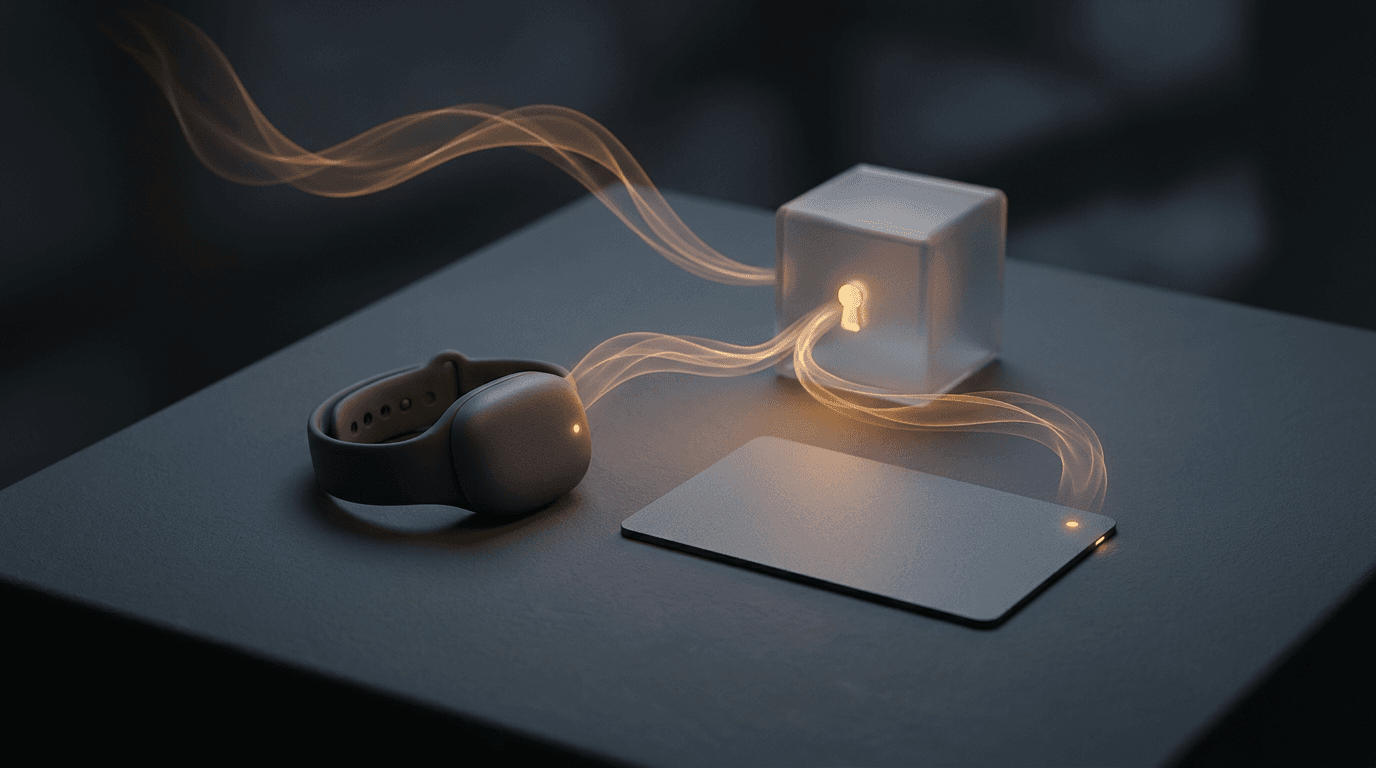
Amazon now sells a $74.99 wristband that listens to your conversations and turns them into summaries and to-do lists. A second device, the $99.99 Bee Eclipse, snaps magnetically onto the back of your phone and does the same job. Its battery is rated for more than 21 days.
Both come from Bee, the AI wearable startup Amazon bought in 2025. The bigger costs may be the $11.99-a-month Bee Pro plan and what you are comfortable recording. Here is what Amazon says, and what it leaves open.
Based on Amazon's Bee announcement and Bee's privacy page, plus reporting from TechCrunch, Engadget, CBS News, 9to5Google and Bloomberg's headline, checked October 16, 2026. We have not used either device. Battery and privacy claims are Amazon's and have not been independently verified.
What Amazon launched
Amazon's Bee Frontier and Bee Eclipse announcement pitches both as "personal AI" note-takers. You press a button, the device listens, and the Bee app produces transcripts, summaries and suggested actions. Amazon's example is a phone call about a holiday, after which Bee pulls out the flight times and hotel bookings.
- Bee Frontier ($74.99, on sale now): a small module you wear in a silicone wristband or clip to clothing. Amazon lists IP67 water resistance, up to seven days of battery life, USB-C charging and dual microphones with noise filtering. Colours are Onyx, Lavender and Sage. It replaces the original $50 Bee Pioneer, which Engadget reports is no longer on sale.
- Bee Eclipse (from $99.99, "available soon"): a credit-card-sized device that attaches magnetically to the back of a phone. Engadget says it has three microphones. 9to5Google reports it works with Qi2 or MagSafe phones. Amazon gives no release date. Colours are Silver, Midnight, Honey and Blush.
Pressing and holding the button lets you ask Bee's AI assistant a question or leave a voice note, according to Engadget. Bee also connects to Gmail, Google Calendar, Outlook, Apple HealthKit and your photos to write follow-up emails or calendar invites. Amazon mentions only Amazon.com, not other countries.
The subscription: free tier vs Bee Pro
Amazon says every buyer gets conversation summaries, recaps and 14 days of memory free. Bee Pro costs $11.99 a month and adds unlimited recent summaries, suggested to-dos, daily memories, a chat assistant, conversation templates, the desktop app, and the Alexa+ and Amazon.com integrations. New customers get 30 days of Pro free.
Our rough maths: if you keep Pro after the trial, the first year costs about $206.88 with a Frontier ($74.99 plus 11 months at $11.99) or $231.88 with an Eclipse. After that, Pro alone costs $143.88 a year. Engadget reports that people who already own a Bee keep their current features. Founder Maria Zollo told the outlet that for them, the "entire featureset is free forever."
The Amazon tie-ins are where the business model shows. Connect Bee to Amazon.com and Amazon says you get personalised shopping recommendations on the Amazon homepage and in the Bee apps. Connect it to Alexa+ and an Echo uses voice ID to read out your Bee insights. Engadget writes that "Amazon stressed that both these features are opt-in."
What Amazon says happens to your recordings
Both devices run on what Amazon calls Bee Private Compute. Here is Amazon's description, in its own words:
- Audio: "No audio is ever stored." Amazon says audio "is processed into insights in real time and deleted after processing."
- Access: processing happens in an isolated environment "where no one, including Amazon, can access your data."
- Transcripts: these are kept. Amazon says they are "encrypted using keys that only your device creates and controls." TechCrunch adds that no one, "including Amazon employees," can open those files unless you deliberately share them.
- Deletion: "You can delete your transcripts and summaries at any time."
- Controls: one press turns either device on or off, and an LED shows when it is on. The Frontier can be set to switch off after a period of silence, such as 5 or 15 minutes.
Engadget reports that the system builds on the AWS Nitro System, Amazon's own cloud security hardware. Bee's privacy page repeats the main points: encryption keys "never leave the device", and audio is "processed entirely in memory and immediately deleted".
The catch: bystanders, training and the details not in writing
The only consent feature Amazon describes is for calls on the Eclipse: users "are prompted to gain permission from call participants each time a recording is started." That is a prompt to you, the owner. Amazon does not say Bee checks whether anyone actually agreed. It says nothing about people near a Frontier in the restaurants and offices it advertises noise filtering for.
The LED is the main signal to everyone else, and Engadget doubts it is enough. Its reviewer notes that the Eclipse "closely resembles a portable battery charger" and that "it can be easy to see how someone might assume an indicator LED means something is charging, rather than listening."
Amazon's announcement also does not say whether transcripts or summaries are used to train AI models. When Amazon agreed to buy Bee, TechCrunch reported in July 2025 that Bee's policy said recordings were "not saved, stored, or used for AI training". We could not find the same promise about transcripts in the current materials. Nor does it say how long transcripts are kept if you never delete them. And "no one can access your data" is Amazon's claim; we have seen no independent audit.
Before you buy or wear one: a checklist
- Tell people. Recording laws differ by country and, in the US, by state. Some places require everyone in a conversation to agree. This is not legal advice. If in doubt, ask first.
- Switch it off by default. Use the single press to turn it on only when you mean to. Set the Frontier's auto-off for silence.
- Do not rely on the LED. On the Eclipse especially, say out loud that you are recording.
- Skip sensitive settings. Think twice about medical appointments and confidential work meetings.
- Decide on the Amazon links. Shopping and Alexa+ integrations are opt-in. Leave them off unless you want your conversations shaping recommendations.
- Delete regularly. Clear transcripts and summaries you no longer need, and revoke Gmail, Calendar or HealthKit access you do not use.
For broader habits, see our AI chatbot privacy guide.
Frequently asked questions
Does Bee record all the time?
Amazon says one press turns each device on or off, with an LED showing when it is on. While it is on it listens to conversations, and the Frontier can turn itself off after a silence you choose.
Do I need the $11.99 subscription?
No. Summaries, recaps and 14 days of memory are free, according to Amazon. Unlimited summaries, to-dos, the desktop app and the Amazon and Alexa+ features need Bee Pro.
When can I buy the Bee Eclipse?
Amazon says only that it "will be available soon", starting at $99.99. The Frontier is on sale now at Amazon.com.
Bee's hardware is cheap and Amazon's privacy promises are specific about audio. They say much less about the people around you, so treat consent as your job, not the gadget's.
About the author
UbedullaFounder & Editor
Founder and editor of The Bot Post, covering AI news and technology.