10,000 or 20,000mAh Power Bank? Work Out What You Need
Compare usable energy, weight and charging output instead of assuming a power bank’s mAh rating equals a fixed number of phone charges.
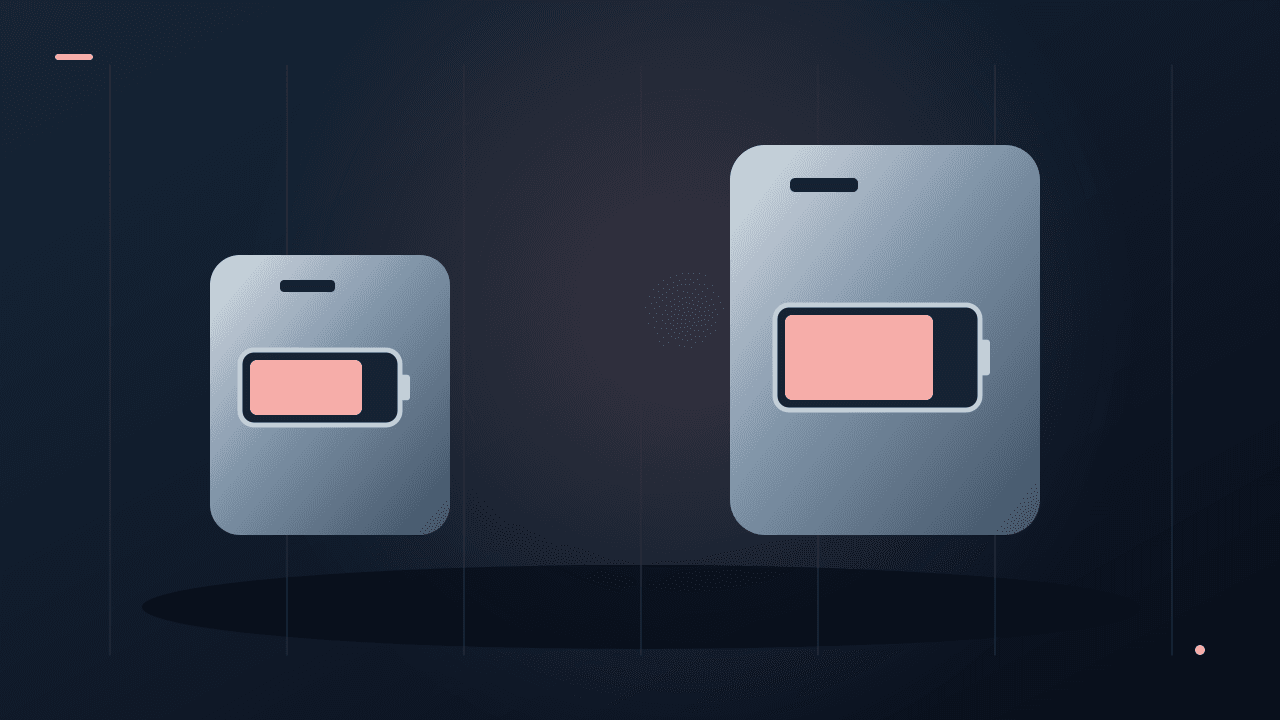
A 20,000mAh power bank sounds as though it should charge a 5,000mAh phone exactly four times. That neat division leaves out voltage, conversion losses and the energy the phone uses while connected.
Choose 10,000mAh for a lighter emergency reserve when its usable energy meets your needs. Consider 20,000mAh when you genuinely need a larger reserve and will carry the extra weight. Neither label tells you charging speed or guarantees a particular number of full charges.Compare energy before counting charges
Milliamp-hours measure electrical charge. Watt-hours measure energy and account for voltage. The conversion is:
Watt-hours = milliamp-hours × voltage ÷ 1,000.
Anker explains this distinction in its mAh-to-Wh guide. Use the voltage and Wh printed on the actual product; do not substitute the USB output voltage for the internal-cell voltage when interpreting its headline capacity.
Here is a deliberately simplified example. A 10,000mAh bank specified at 3.7V contains 37Wh nominally. A 5,000mAh phone battery specified at 3.85V contains 19.25Wh. Before losses, 37 divided by 19.25 is about 1.92—not exactly two, and certainly not a guaranteed result.
If we assume an illustrative 75% of the bank's nominal energy ultimately reaches the phone battery, the result becomes about 1.44 equivalent full charges. A 20,000mAh bank at the same assumed voltage and efficiency would give about 2.88. The 75% figure is an example assumption, not a tested efficiency or a universal specification.
Why the number on the box is not the delivered amount
Power conversion and charging involve losses, and a phone consumes energy if you use it during charging. Anker's rated-capacity explanation distinguishes internal capacity from output capacity. Where a manufacturer provides a rated output capacity, check the voltage and conditions attached to it.
The practical question is usually smaller than “How many zero-to-100 charges?” You might need to finish a navigation-heavy afternoon with 30% remaining. Another person needs to support two phones away from sockets for a weekend. Those are different energy budgets.
Write down which devices you will carry and how often you expect access to a wall outlet. Include earbuds, a camera or a second phone if they share the bank. Do not rely on the power bank's percentage display as a precise energy measurement.
Capacity and charging speed are separate purchases
A large bank with weak output can hold plenty of energy while charging a demanding device slowly. Check the output protocol and the wattage of the particular port you will use. If you want to charge a laptop, verify that laptop's requirements instead of assuming a USB-C socket is enough.
Also check input power. A bank that lasts through a long day is less convenient if your charger cannot refill it during the time available. Manufacturer recharge-time claims normally depend on a specified adapter and cable.
Our USB-C charger checklist helps match those parts. Multiport sharing matters on power banks too: the maximum with one device attached may differ from simultaneous output.
The carry test matters
Compare the actual weight and dimensions in the specification sheet. Imagine the bank in the bag or pocket you use every day, along with its cable. A larger reserve left at home is no reserve at all.
For commuting with predictable access to sockets, start with the smaller option that covers your worst ordinary day. For long outings with navigation and photography, a larger bank may be worth its bulk. For air travel, check your airline's current battery rules and the product's marked Wh before buying; this guide is not a substitute for carrier requirements.
Can I leave the bank permanently connected to several devices?
Do not assume pass-through charging is supported or suitable for that setup. Check the manufacturer's instructions for the exact model. Stop using a bank that is swollen, damaged or behaving abnormally, and follow its service or disposal guidance.
Original arithmetic and documentation-based advice, checked October 8, 2026. No power bank was capacity-tested. Example charging counts are estimates under stated assumptions.About the author
UbedullaFounder & Editor
Founder and editor of The Bot Post, covering AI news and technology.