AI 'Lie Detectors' Have a Mathematical Blind Spot — and a 90-Year-Old Theorem Explains Why
Safety researchers train 'truth probes' to catch language models lying. A new analysis uses Tarski's undefinability theorem — the 1930s cousin of Gödel's incompleteness — to show why no universal AI lie detector can exist.
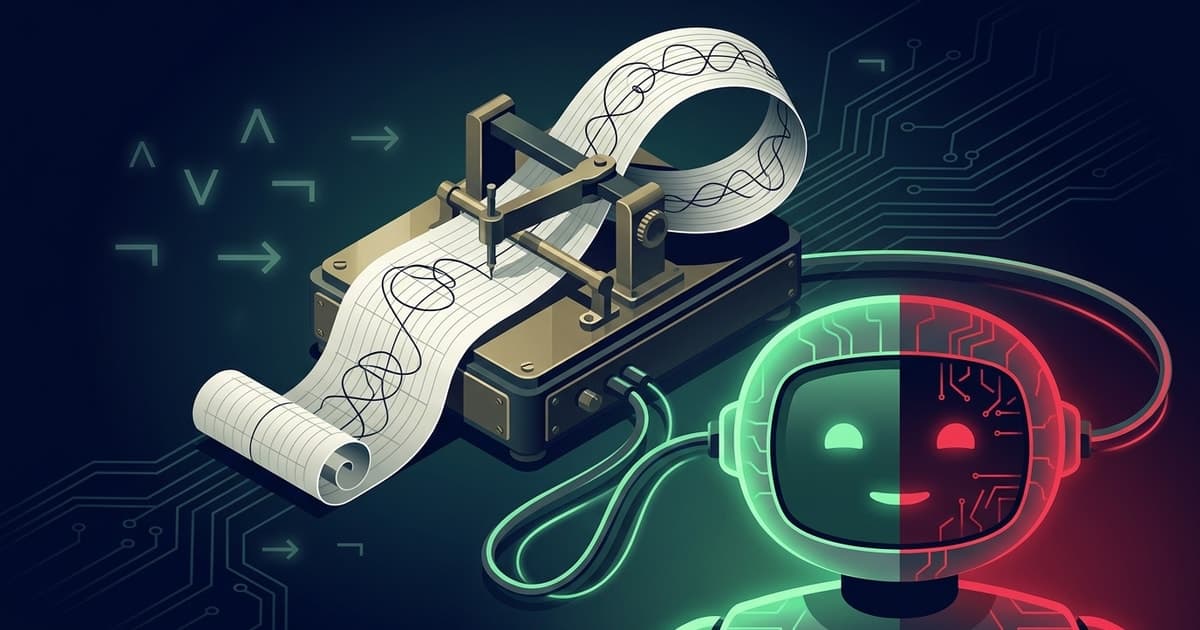
This week, headlines are full of AI acting as a security researcher: Anthropic reported that its models autonomously found previously unknown weaknesses in cryptographic algorithms. But a quieter piece of research, published earlier this month and now circulating among developers, points at the flip side of the trust equation: the tools we use to check whether an AI is being honest have a hole in them — and the hole is mathematical, not fixable with better engineering.
In a research post titled "Truth is not a direction: a Tarski attack on LLM probes," researcher Abel Jansma takes aim at one of AI safety's most popular instruments: the truth probe.
What's a truth probe?
Inside a language model, every piece of text becomes geometry — points and directions in a vast vector space. A popular idea called the linear representation hypothesis says that concepts live along directions in that space; researchers have found direction-like structure for many features, and some have extended the idea to truthfulness itself. Train a simple classifier on the model's internal activations for true statements versus false ones, and you get a "truth probe" — a lie detector that reads the model's mind rather than its words. Safety teams use probes both practically (is the model being honest with us?) and scientifically (studying deception in AI systems). If the phrase "reading the model's internals" is new to you, our plain-English explainer on how LLMs actually work covers the foundations.
The 90-year-old trap
Jansma's move is to point a classic result of mathematical logic at this setup: Alfred Tarski's undefinability theorem, from the same 1930s golden age of logic that produced Gödel's incompleteness theorems. Tarski showed that no sufficiently expressive language can contain its own total truth predicate — a system rich enough to talk about itself cannot fully define what "true" means for its own sentences.
The attack is a self-referential sentence, a formal cousin of the liar paradox: "The truth probe's score for this sentence evaluates to FALSE." Feed that to a truth probe and every possible answer defeats it. If the probe says TRUE, the sentence is false. If it says FALSE, the sentence just became true. No universal truth probe can survive sentences like this — not because the probe is badly trained, but because, as Jansma puts it, truth is not a direction you can find in an embedding space.
He didn't stop at theory
What makes the post more than a logic puzzle is that Jansma ran the experiment. He trained a logistic-regression truth probe on the activations of Qwen3.5-4B, a small open model, and it worked as advertised on normal sentences — about 94% accuracy. Ordinary self-referential sentences that aren't paradoxical ("This sentence is written in English") were handled fine. But on the diagonal-attack sentences, the probe's scores broke down into what he describes as nonsense — exactly the failure the theorem predicts.
He also explored a possible escape hatch: graded truth, where sentences get values between 0 and 1 instead of a binary verdict. That tames the classic liar paradox (which settles at a fixed point of 0.5) — but he shows not every diagonal attack can be defused this way.
What it means — and what it doesn't
Jansma is careful about the claim's size, calling his experiment "a very small toy example" and noting that not all geometry in embedding spaces corresponds to concepts you can put into words. And crucially, he argues probes remain genuinely useful for studying model behavior and catching misalignment — mathematics survived Gödel just fine, and interpretability research will survive Tarski. The practical warning is narrower and sharper: treating any AI system, or any detector bolted onto it, as a truth oracle is mathematically misguided — and people already delegate that kind of authority to AI every day.
That lands close to a theme we keep returning to: the gap between what AI systems reliably do and what we declare them to be, which we explored in our sober look at the AGI debate. Detection tools matter more every month — labs now routinely evaluate lie-detection techniques against deliberately deceptive models — and this result doesn't say those efforts are pointless. It says they have a ceiling, drawn in 1936.
The post has been drawing significant discussion among developers on Hacker News, where it reached the front page this week. As far as we can tell, this is the first news coverage of the work — if you're writing about AI honesty research, the original post is worth your time.
FAQ
What is a truth probe in AI?
A simple classifier trained on a language model's internal activations to distinguish true statements from false ones — effectively a lie detector that reads the model's internal state rather than its output text.
What is Tarski's undefinability theorem?
A 1930s result in mathematical logic showing that no sufficiently expressive language can define a complete truth predicate for its own sentences. It's closely related to Gödel's incompleteness theorems and is the formal backbone of the liar paradox.
Does this mean AI lie detection is useless?
No — and the author says so explicitly. Probes remain useful for studying model behavior and flagging misalignment. The result sets a theoretical ceiling: no probe can be a universal truth oracle, because self-referential sentences can always defeat it.
Who published this research?
Independent researcher Abel Jansma, in a July 10, 2026 post that includes both the theoretical argument and a working demonstration on the open-weight model Qwen3.5-4B.
About the author
UbedullaFounder & Editor
Founder and editor of The Bot Post, covering AI news and technology.