Wall Street Is Rotating Out of AI: Inside the $3.3 Trillion Chip Selloff
Semiconductor stocks have shed trillions in weeks, a single Monday wiped out over $1 trillion, and the money is flowing into industrials, banks, and energy. What's actually driving Wall Street's great AI rotation — and what it isn't.
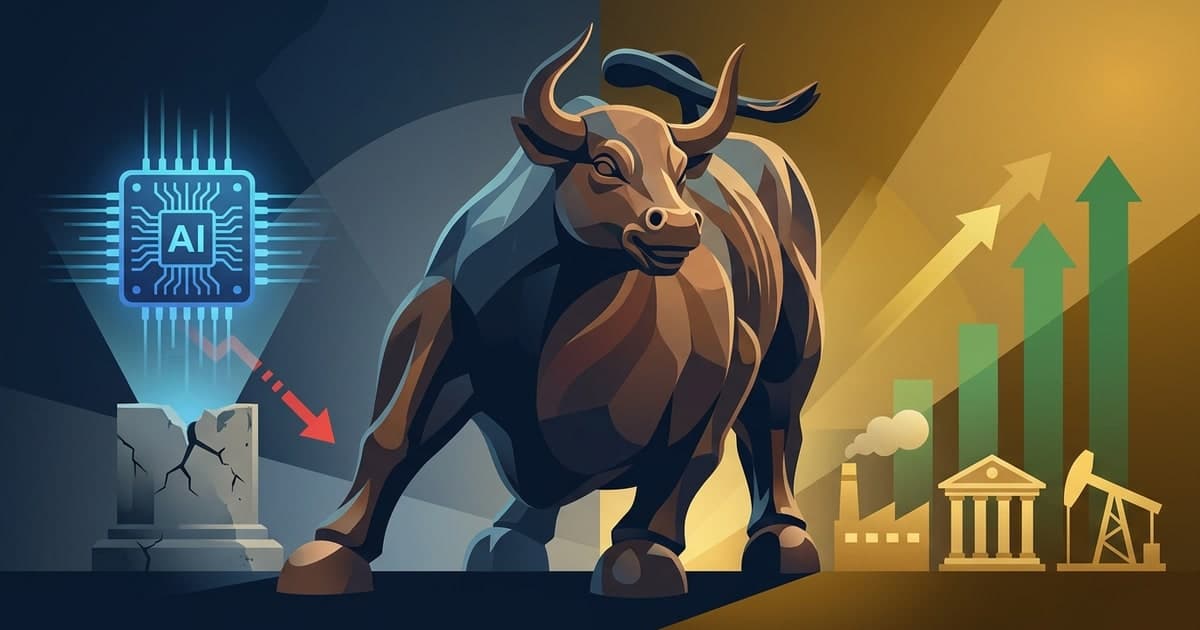
For nearly three years, the trade that defined Wall Street was simple: buy the companies building AI, especially the chips underneath it. This month, that trade cracked. By one widely cited tally, global semiconductor stocks have lost roughly $3.3 trillion in market value since June 22 — and the selling accelerated into this week, even as most of the rest of the market quietly went up.
That last part is the real story. This isn't a market crash; it's a rotation — money moving out of the most crowded trade of the decade and into nearly everything else.
Monday's trillion-dollar session
The ugliest single day came on Monday, July 27, when more than $1 trillion was wiped from U.S. stocks — with roughly half the damage concentrated in just six memory-and-AI-adjacent names, according to Benzinga's tally: Nvidia (about $300 billion in lost market value), SK Hynix (~$95 billion), Micron (~$82 billion), SanDisk (~$26 billion), Western Digital (~$21 billion), and Seagate (~$17 billion). Nvidia closed the session down 4.99% at $196.51.
The trigger was a report in The Information that a state-backed Chinese manufacturer had reached mass production of domestically developed DUV lithography systems — the machines that make chips. If China can equip its own fabs at scale, the thinking goes, it can flood the market with memory chips and eventually compete higher up the stack. Counterpoint Research analyst MS Hwang noted that Chinese companies expect to begin producing HBM3 — the high-bandwidth memory that feeds AI accelerators — in the first half of 2027, by which point Micron, SK Hynix, and Samsung are expected to have moved on to HBM4. A generation behind, but closing.
Adding to the nerves: reports that SK Hynix plans to slow its HBM production expansion, and the sheer distance these stocks had already run. Even after weeks of selling, mid-July figures showed Micron still up roughly 197% and SanDisk up 471% for the year. When positions are that extended, it doesn't take much to start an avalanche of profit-taking.
Where the money went instead
Tuesday made the rotation explicit. While chip stocks fell for a second straight day, the Dow rose about 1% and the equal-weighted S&P 500 — the version where Nvidia counts the same as a railroad — hit a record high, according to market wrap coverage. The tech-heavy Nasdaq 100, meanwhile, drifted toward correction territory.
The destinations are the sectors that spent three years being ignored: industrials, regional banks, healthcare, consumer staples, energy, and small caps. Treasuries gained for a third straight session, and falling oil — Brent just posted its worst three-day stretch since 2020 — added a tailwind for the industrial economy that AI infrastructure never needed.
There's a rate-policy wrinkle too. Unusually for a big tech drawdown, mid-July futures markets were pricing meaningful odds of a September rate hike rather than a cut — around 52%, per data cited by ABC News. Expensive borrowing is a bigger problem for companies planning hundred-billion-dollar data-center buildouts than for a regional bank or a railroad.
Is the AI trade over? What the selloff is — and isn't
It's worth being precise about what's being repriced. Nobody on Wall Street is arguing that AI adoption is reversing. The repricing is about how much hardware that adoption ultimately requires, and at what margins. Cheaper, more efficient model architectures keep demonstrating that useful AI needs less raw compute than the 2024-25 projections assumed — a trend we've tracked in our piece on why smaller AI models keep getting better. If the future needs fewer chips per unit of intelligence, the premium multiples on chipmakers have to shrink, even in a booming AI economy.
The counterweight: the physical buildout is still enormous — data-center capacity, power, and enterprise adoption keep setting records, as we covered in our mid-2026 state of AI report — and the six names that led Monday's losses are the same ones that led the past year's gains by huge margins. A crowded trade unwinding violently is not the same thing as a thesis dying.
The next test arrives within days: Microsoft and Meta report earnings Wednesday, Apple and Amazon Thursday, with a Federal Reserve decision also due this week. If Big Tech's capital-spending guidance stays aggressive, the "AI demand is fine, the chips were just expensive" reading wins. If the guidance softens, this rotation has further to run.
FAQ
Why are AI and chip stocks falling in July 2026?
Three forces stacked up: fears that China's new domestic chipmaking capability will erode memory-chip pricing power, reports of slowing HBM expansion at SK Hynix, and heavy profit-taking after historic runs — some memory names were up 200-470% on the year before the slide. A less friendly interest-rate outlook added pressure on capital-intensive AI infrastructure plans.
Is the AI bubble bursting?
The evidence so far points to rotation, not collapse. On the worst days for chip stocks, the Dow rose and the equal-weighted S&P 500 set record highs — money is moving between sectors, not leaving the market. Analysts remain divided on whether chip valuations have further to fall.
What is a sector rotation?
It's when institutional investors shift money from one group of stocks to another — here, out of mega-cap tech and semiconductors and into industrials, financials, healthcare, energy, and small caps that lagged during the AI rally.
What are the key events to watch this week?
Earnings from Microsoft and Meta on Wednesday and Apple and Amazon on Thursday — especially their AI capital-spending guidance — plus the Federal Reserve's policy decision. Those will largely determine whether the chip selloff stabilizes or deepens.
This article is news reporting and analysis, not investment advice.
About the author
UbedullaFounder & Editor
Founder and editor of The Bot Post, covering AI news and technology.